

In, Politics and the English Language, George Orwell wrote, “Political language – is designed to make lies sound truthful and murder respectable, and to give an appearance of solidity to pure wind.”
Language, a structure of symbols used and made by humans consisting of sounds and gestures. It is so natural, so imbibed within us and still something that is never in our conscious stream of thought.
The ability to form an unlimited number of thoughts into spoken words is what separates human beings from our less-evolved cousins. It’s surprising how alphabets, letters, and words that are just symbols, essentially mean nothing in themselves—we have attached meaning to them, to the extent that they hold so much power over us.
As Saussure said, language is just composed of signifiers and signifieds and the connection between the two is arbitrary, not to mention that each signified is just another signifier. “A person’s choice of language can affect not only how another person feels but how they perceive events around them” is a finding of so many studies.
This headline is proof of that -
“Hundreds killed in explosion at a crowded Gaza hospital”.
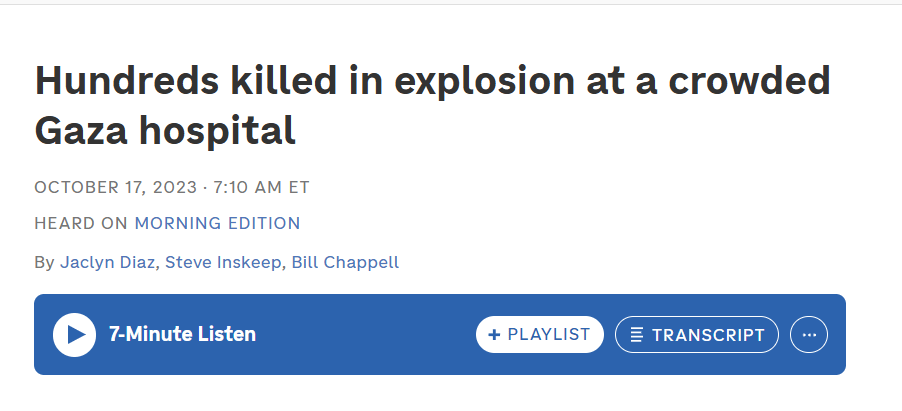
Doesn’t it create a perception that the killing of Palestinians was not a result of an attack but rather had something to do with it being overcrowded? Such a convenient way to not hold those responsible accountable for their actions.

Framing, in journalism and otherwise, ascribes meaning to an issue. It takes place on both sides of the communication, the sender and the recipient. Political framing is a technique that is used to influence the direction of a political debate and the attitudes of people towards an issue by using language. And this is something so subtle, so implicit that one doesn’t even care to notice it but it does change the behaviour, making one more biased without any grounds.
Unfortunately, these biases are proliferated further. Every time ChatGPT automatically makes a nurse, a coloured woman and an engineer a white man, know that it is a result of an inherent bias. A bias of whom? Of the person feeding AI with this discriminatory information.
AI relies on statistical patterns and doesn’t fully understand the context or subtleties of language. These models are fed massive amounts of text and data on the internet, which they use to predict the most likely sequence of words in response to a prompt. It is the job of the person doing the feeding to manage the content, but unfortunately, nowadays AI just steals from whatever is available and listens to its all-controlling master.
While on the topic of words, the humongous role of labels can’t be ignored. Just a word attached to something or someone, whose implications are so extreme. Be it any mental disorder, disease, condition, age, race, or gender, there is a label for everything and in a lot of cases, it doesn’t even do justice to the condition.
How can one encapsulate all the features of a thing under a ‘label’? Yes, labels do hold importance, but in the process of using labels do we end up disassociating with the content and nuances beneath the label?
There is this technique called defamiliarisation, Victor Shklovsky, in Art as Technique, using Tolstoy’s example, explains it:
“Tolstoy makes the familiar seem strange by not naming the familiar object. He describes an object as if he were seeing it for the first time, an event as if it were happening for the first time. In describing something, he avoids the accepted names of its parts and instead names corresponding parts of other objects.
For example, in Shame, Tolstoy “defamiliarises” the idea of flogging in this way: “to strip people who have broken the law, to hurl them to the floor, and “to rap on their bottoms with switches,” and, after a few lines, “to lash about on the naked buttocks.” Then he remarks: Just why precisely this stupid, savage means of causing pain and not any other - why not prick the shoulders or any part of the body with needles, squeeze the hands or the feet in a vise, or anything like that?I apologize for this harsh example, but it is typical of Tolstoy’s way of pricking the conscience. The familiar act of flogging is made unfamiliar both by the description and by the proposal to change its form without changing its nature.”
Language solely depends on how it is being used. We should inspect each word that we read and write because as Orwell said in 1946, “But if thought corrupts language, language can also corrupt thought.”
 |
|